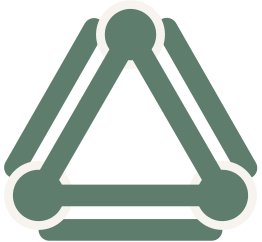
Specification uses what's needed to determine what should be built. Validation uses what's been built to test whether the need was right. One translates intent into form. The other holds form up against intent and asks: does this actually serve the purpose? When both activities dominate someone's attention, they create a circuit between Need and Solution that can iterate indefinitely.
The loop works like this. Specification takes the current understanding of Need and determines what Solution should look like: requirements, architecture, success criteria. Validation takes whatever exists of Solution and asks: but does this actually address the underlying need? That question almost always surfaces a gap. The spec missed something. Or the need was subtler than the spec captured. Or testing against reality revealed that the need itself wasn't what anyone thought. So the need gets refined. Which means the spec needs updating. Which means the design changes. Which produces a new version to validate against the updated need. Which reveals another gap. Which...
Purpose and form chase each other. The alignment between what's wanted and what's defined tightens with every pass. And each pass is genuinely productive. The understanding of need improves. The articulation of the solution improves. The fit between them improves. This feels like the most intellectually honest version of making. Every decision is tested. Every assumption challenged. Nothing survives that isn't justified.
The problem is that the loop converges on paper.
Resources goes unattended
The system this circuit doesn't touch is Resources. Capabilities, tools, skills, time, budget, capacity to execute: none of it enters the conversation. The loop asks "what should we build?" and "is this what's needed?" It never asks "can we build it?"
That question sounds mundane next to the loop's preferred questions. Purpose, form, alignment, fit: these feel like the important words. Capacity feels like logistics. Something to worry about later, once the design is right. But "later" has a structural problem. The loop doesn't have a later. It doesn't terminate. There's always another validation cycle revealing another nuance in the need, triggering another specification revision. The design gets more refined, more validated, more aligned. And the gap between what's been designed and what can actually be executed widens quietly because nobody is attending to it.
Delivery would turn capacity into concrete output. Provisioning would build capabilities toward what's needed. Scoping would bound the design to what's feasible. Verification would let actual output teach you about your process. All four engage Resources. All four live outside this circuit. Without them, you get understanding without production. Alignment without execution. Rigor without result.
The distinctive frustration
The readiness loop produces someone who knows they haven't shipped but feels about to. The production loop produces someone who ships constantly and doesn't realize they're off-target. The design loop produces someone who can articulate exactly what should be built and exactly why, and feels increasingly puzzled about why it doesn't exist yet.
The design is right there. It's been validated. It's aligned. The next step is obvious. And somehow the next step keeps not happening, because the next specification revision is always slightly more urgent than the first attempt at execution.
Someone who leads with Specification and flows into Validation is a designer who tests. They articulate the solution, then check it against purpose. Their trap is the ever-more-perfect blueprint. Each validation cycle produces not a decision to build but a decision to re-specify. The blueprint becomes the artifact. Version 14 of the requirements document is the thing that actually got made.
Someone who leads with Validation and flows into Specification starts from evidence. They look at what exists and interrogate its purpose-fit. This surfaces need-gaps, which trigger specification work. Their version has a more critical feel. Less "let me design this" and more "this isn't right yet, here's why." They become the permanent questioner, perpetually identifying why the current design falls short without switching to the mode that would produce something better. They know what's wrong. They can say what's needed. They can't get from knowing to building.
Where this shows up
Startups die in this loop. The ones that do extensive customer discovery, validate their market thesis, design thoughtful solutions, test with potential users, refine based on feedback, and run out of money before shipping. The validation was genuine. The specification was thorough. The product-market alignment was better understood with each cycle. None of it generated revenue because none of it generated a product.
Academic work crystallizes here. A researcher refining the research question based on preliminary findings, each refinement producing a more precisely specified study, piloted and re-validated, the pilot revealing new dimensions, the question getting more nuanced, the study design more sophisticated. The dissertation stays in the design phase for years because the question is always getting more interesting than the answer.
Personal decisions too. Someone renovating a kitchen who researches layouts, specifies fixtures, gets family feedback on whether the plan serves their cooking needs, revises, re-validates. The kitchen stays gutted. Not because they can't hire a contractor. Because the design isn't finished. It won't be finished. It can't be finished, because every validation cycle reveals something the next specification should address.
The missing category of information
The design loop's blind spot has a specific structure. It can tell you what should exist and whether that thing would serve the need. It cannot tell you whether you can make it, what making it would cost, or what you'd learn from the act of making it.
That last point matters more than it sounds. Some of the most important information about both Need and Solution only becomes available through the act of production. You can specify and validate a software architecture indefinitely, but certain performance characteristics only reveal themselves in implementation. You can design and user-test a physical product, but certain manufacturing constraints only surface when you try to build it. You can research and refine a business model all year, but certain market dynamics only become visible when you actually sell something.
The design loop treats Solution as a conceptual object: something to be defined and evaluated. Delivery treats Solution as a physical one: something to be produced. And production generates a category of feedback that conceptual evaluation cannot. The prototype that fails teaches you things the blueprint never could. Not because the blueprint was wrong, but because reality has higher resolution than any specification.
So the loop isn't just failing to produce output. It's cutting itself off from an entire class of information that would improve the very things it's trying to improve. The need-understanding would be richer with concrete output to validate against. The specification would be better with execution constraints informing it. The loop is perfecting its understanding while denying itself one of the primary channels through which understanding actually improves.
Building as a design instrument
The response to the design loop isn't less rigor. It's rigor with material. The instinct toward careful evaluation is this loop's native language. The corrective isn't the opposite of that instinct. It's a different kind of input.
Build something. Not because the design is done. Build because the design isn't done and can't be done without the information that only building provides. The prototype isn't a concession to impatience. It's a validation instrument that generates higher-resolution evidence than conceptual evaluation alone can produce. It also forces a Scoping question the design loop never initiates: what can we actually produce given current capacity?
For the person who lives here: you're probably right that the design isn't finished. You're probably right that what exists doesn't fully serve the need. Both perceptions are accurate. What you're missing is that the path to a finished design runs through making things, not around it. The imperfect artifact is the instrument, not the obstacle. The thing you resist producing is the thing that would break the loop by feeding it information from outside its own boundaries.